Village, Hamlet or Town: What the Labels Can and Cannot Tell You
Village, hamlet or town labels can obscure more than they explain. Compare local usage, administration and built form to describe each settlement precisely.

The common mistake with village, hamlet or town is to treat the label as a headcount. That can make a map seem clearer than the place itself: a small town may be called a village locally, while an officially designated town may feel little different from its neighbours. Village, hamlet or town labels are useful clues, not universal measuring tools.
A label can describe local custom, administrative status or a settlement’s apparent scale, and those meanings do not always coincide. Comparing them is less a matter of following a schedule than of checking what each source means and keeping observation separate from classification.
Separate the label from the settlement
“Village”, “hamlet” and “town” are ordinary words, but they can also have administrative or historical meanings in particular places. Their definitions vary between countries and regions, and sometimes between neighbouring authorities. There is no single global rule that turns a particular number of residents into a village or a town.
Start with the exact wording on the source you are using. A road sign, postal address, local council page, map legend and community website may each use a different label for the same place. Note who uses the term and what kind of source it is, rather than treating every use as an official classification.
Keep three questions apart: what the settlement is called, how it is governed, and what it is like on the ground. A place can have a village name, a parish or other local administrative body, and a commercial centre serving nearby settlements. Those facts can coexist without one deciding the meaning of the others.
Compare maps, administration and services
Choose a small group of neighbouring places and note the labels used on a reliable map and on local signs. Record the source and the date you consulted it, since maps and administrative pages can change. Establish which names and labels are in circulation before trying to rank the places.
Check the local authority’s information for terms such as civil parish, ward, municipality or settlement area. These describe different kinds of administration, and the terms do not translate neatly from one jurisdiction to another. If a page gives an official designation, quote it precisely instead of turning it into a general claim about the settlement’s size.
Then look at service information: schools, shops, public transport, a health centre, a library or a village hall. Services indicate what people can reach and what role a settlement may play for its surroundings. They do not define its label: a service may serve several places, sit outside the centre or have closed while the name remained.
Read the built pattern as evidence
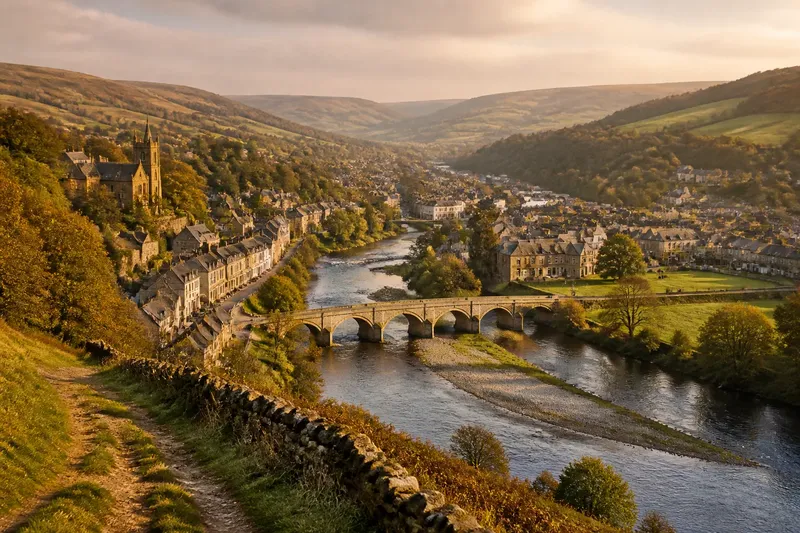
Compare the visible form of each settlement. Does it have a compact centre, homes spread along roads, several separated clusters, or a mix of older and newer areas? Look at how homes, workplaces and public buildings relate to one another rather than assuming that one church, shop or main street determines the category.
Density and continuity can make a town feel different from a hamlet, but appearance remains evidence to interpret, not a universal threshold. A village may have a substantial centre because it serves surrounding countryside. A small town may have a dispersed edge where later building extends beyond its older core.
Say you are comparing two invented places shown on the same local map. The first has a compact row of shops and a bus stop; the second has homes spread between several lanes and no central service. You can describe the first as having a more concentrated service centre and the second as more dispersed, but those observations alone do not establish official status.
Settlement labels resemble filing labels on boxes: useful for sorting, but poor substitutes for knowing what is inside or how it got there. They offer shorthand, not a complete portrait.
How should you handle competing settlement labels?
Does a village have to be smaller than a town?
Not by a universal rule. The words often suggest relative scale in everyday speech, but local convention, administrative designation and historical usage may point in different directions.
Is a hamlet always a group of only a few houses?
“Hamlet” commonly suggests a small settlement, often without the range of services found in a larger centre. Its precise meaning varies, so describe the observable pattern rather than treating the word as a fixed housing limit.
Can a place be officially a town but called a village?
Yes. Formal designation and familiar local usage can differ, and people may retain an older or more intimate name for their community. State which usage you mean when the distinction matters.
What should you call a place if sources disagree?
Use the source that fits your purpose and identify its wording: for example, “the council lists it as a town” or “local signs call it a village”. If no designation is relevant, “settlement” is a neutral general term.
Choose a description that fits the evidence
Compare your notes and separate direct observations from classifications. “The centre has several shops” is an observable description. “It is therefore a town” is a conclusion that needs a locally relevant definition, not merely an impression of scale.
Imagine you are writing about two invented neighbouring places. Your map labels one a village and the council page lists it as a town; local signs use “village”. The other has homes along several lanes, a hall and no listed official designation. You would record the first as officially designated a town but locally called a village, and describe the second as a dispersed settlement unless a relevant source supplies another classification. The trade-off is clear: the first description preserves the disagreement, while the second avoids claiming a status the available evidence does not establish.
For each place, check the following observations and let the result guide the wording:
- Observation: the map gives a specific label. If the map is the source relevant to your purpose, use that label and name the map when precision matters; otherwise, compare it with local and administrative sources before choosing.
- Observation: the council page gives a formal designation. If that designation is relevant, quote it precisely; otherwise, describe the settlement without treating the administrative term as a general size category.
- Observation: local signs or community material use a different name from official records. If local usage is relevant, state that wording alongside the formal designation; otherwise, retain the source most appropriate to your purpose.
- Observation: shops, transport or public services serve several neighbouring places. If their role is shared, describe the service catchment rather than using the service to classify one settlement; otherwise, note the service as a feature of that place.
- Observation: buildings form a compact centre or a dispersed pattern. If the pattern is clear, describe it directly; otherwise, avoid implying a settled form and identify the visible mix.
- Observation: the available sources disagree or give no relevant designation. If the disagreement affects your account, report the competing usages; otherwise, use “settlement” as a neutral term.
Where a label depends on a legal or administrative designation, follow the relevant authority’s terminology and local rules. That matters particularly in official material; casual usage and formal classification need not serve the same purpose.
Village, hamlet or town is most useful as a prompt to ask who is using the label and what they are trying to distinguish. Keep that question beside the name, and the description can be precise without pretending that one category tells the whole story. When comparing village, hamlet or town labels, naming the source and the feature being compared often makes the distinction more useful than choosing a single winner.