The Clues Hidden in a Place Name
Explore a place name’s possible origins by separating documentary evidence from attractive stories, and build an explanation that shows what is known and what remains open.

The common mistake with a place name is to treat a neat story as its origin; the cost is turning a plausible guess into local fact. Exploring a place name’s possible origins works better when you keep the appealing explanation separate from what the records actually support.
Imagine a fictional settlement called Merewick. A local account says the name means “the bay where a mare was found”, and a carved horse above the old inn seems to make the story fit. The name, the tale and the carving are clues, but none establishes the others. The task is to find out what each can genuinely tell you.
Start with the name as it appears now
Write down the current spelling, but do not divide it into meaningful parts yet. A modern form can suggest familiar words that were not present when the name took shape. Pronunciation may also preserve a feature that the spelling has obscured, so note how residents say it and whether pronunciations vary.
For Merewick, a reader might initially hear “mere” as a lake and “wick” as a settlement. That is a useful question to carry into the records, not a translation. The same sound could have arrived through older spellings, changes in pronunciation or a language no longer spoken locally.
Find the earliest forms before interpreting them
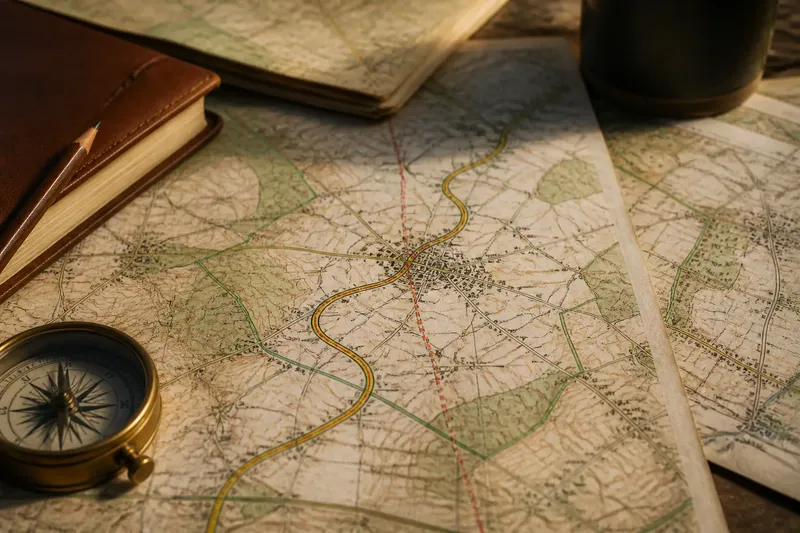
Search for the settlement in old maps, local directories, parish records and place-name indexes. A county archive or local history library may hold material that is not available through a general web search. Record each form with its date and source, and distinguish a transcription from an image you have checked yourself.
Say the earliest form you locate for fictional Merewick is “Merwic”, appearing in a copied parish register, while a later map gives “Merewyk”. The register offers a lead, but its copy may contain a spelling error; the map shows another form, not necessarily a more accurate one. Looking for independent appearances helps establish whether a form was in use or was simply repeated from one document.
Keep a small evidence table as you go:
- Form: the spelling as recorded, including any uncertainty in reading it.
- Source: the document, map or index where it appears.
- Date: when the source was made, rather than a date assigned to the name itself.
- Context: whether the entry concerns the settlement, a person, a field or another feature.
- Confidence: whether the form is directly visible, transcribed or reported by someone else.
This is less romantic than spotting a horse in a pub sign, but a ledger is much like a torch: it helps you see the path without choosing the destination.
Test each proposed meaning against the record
Once you have a sequence of forms, consider possible elements one at a time. Ask whether the proposed sounds fit the older spellings, whether the suggested language was used in the area, and whether the proposed meaning makes sense for the name’s role. A similar-looking word elsewhere is not enough; spellings can converge by accident.
For Merewick, “mere” might plausibly point to a body of water, while “wick” has several possible histories in English place names. The fictional settlement sits near a marsh, but that landscape alone does not decide which meaning applies. A local feature can support a reading, yet it cannot replace linguistic and documentary evidence.
Check the scale of the name as well. It may have begun as the name of a farm, stream or estate and later been applied to the settlement. If a record uses the form for a person’s holding rather than the village, interpreting it as a direct description of the village could lead you astray.
Keep the horse story in its proper place
The tale about a mare may explain why the inn displays a horse, or it may have arisen from the name itself. Either way, the carving is evidence of a local association, not proof of the name’s original meaning. Ask when the story first appears in writing and whether its wording changes between accounts.
If the earliest written version is recent, describe it as a local tradition rather than an established etymology. If it appears in a source close to the name’s earlier forms, it deserves attention, but still needs to be read alongside other evidence. Oral accounts can preserve valuable knowledge; they can also gather new details as they pass from teller to teller.
What should you do when the records disagree?
Should the oldest spelling decide the meaning?
It deserves weight, but age alone does not make a document accurate. Check how the source was produced, whether its reading is secure and whether another independent record supports it.
Can the landscape confirm a proposed meaning?
It can make an interpretation more or less plausible, especially when an older feature is still identifiable. A marsh, hill or crossing is supporting context, not a translation of the name.
What if a familiar word fits the current spelling?
Compare it with earlier forms and local pronunciation before accepting the match. Modern spelling may invite a false division into words that were never part of the name’s history.
Write the result with its uncertainty visible
A careful account distinguishes among what a source records, what an interpretation proposes and what a story remembers. For fictional Merewick, the evidence might support an early form resembling “Merwic”, while leaving the elements unresolved. The horse tale could be noted as a later local explanation, with its earliest known appearance identified if that information is available.
Useful wording is specific about the limits: “The early forms are consistent with this reading, though they do not settle it,” or “A local tradition connects the name with a mare, but the surviving records do not confirm that account.” Avoid making uncertainty sound like failure. In place-name work, an open question is often more informative than a tidy answer.
Keep your notes attached to their sources so another reader can check the same trail. The most useful result may be a modest one: an early spelling, a plausible line of interpretation and a story clearly marked as tradition. That leaves the name with room for its real history, rather than forcing every clue to tell the same tale.